Search 
Monday, September 06, 2010 ..:: Installation in Pictures » Rerun of the Heat Run ::.. Register  Login
Filter Options for Heating and Furnace
One of the easiest things you can do to impact your heating efficiency and indoor air quality is to have the proper filter system installed and well maintained. There are a number of different materials and methods available to you for filtration. Be sure to check with your heating professional to get the right one for your furnace.
Filters are available in a large number of sizes and materials. The filter industry has adopted a standardized rating system to help consumers know the level of filtration offered. The MERU rating should be displayed on the filter packaging. Before you make a decision to change your furnace filter type you should consult a HVACs specialist as higher MERU filters can reduce the amount of air that is able to pass through them. Less air passing through your furnace filter could negatively impact upon your furnace and its performance.

Furnace filters types:
Fiberglass particle filter - These inexpensive disposable filters stop large particles from entering the furnace and being sent through the ductwork into the house. They do not help filter particles that worsen allergies etc.
Passive electrostatic filter - These washable filters use a static charge to attract particles. They filter smaller particles than the fiberglass filter but are only able to block a minority of particles in the air.
Pleated filter - An increase in the surface area of the filter helps trap larger particles by allowing a finer mesh pattern without interrupting air flow to the furnace.
Electronic filter - One of the most effective options that comes with a price. Electronic air filters are expensive costing several hundred dollars but they do trap as much as 80-90% of airborne particles. If you are concerned about allergies or illness this is a good choice for your home.
HEPA filter - Traps more air particles than any other filter but are typically only used in commercial buildings.


Types of Heating and Furnace

Below you will find the most common heating options briefly described.
Gas & Oil Furnace
Heat Pumps - Heat pumps transfer the heat that exists within the air from one place to another. They offer both heating and cooling though in a less dramatic fashion than forced air heating and cooling options.
Electric Heaters - The most typical style of this type of heating is the baseboard heater. The unit warms air that come in contact with its heating element. That heat rises and cooler air is forced downward and comes back into contact with the heater element.
Radiant Heating - Radiant heating is a system that involves using cables or heated water in pipes and placing them in a non carpeted floor, walls and even your driveway. This form of heating is gaining popularity in recent years and is sometimes used as a supplemental heating option within homes.
Corn Furnaces - Increasing in popularity due to the fact that corn is a renewable energy source and offers real savings over natural gas, oil, and electricity. Corn furnaces are surprisingly safe, clean and easy to use. - Both gas and oil furnaces heat air as it is passed over a heat exchange unit. Air is drawn into the furnace, heated and then forced back into the home through ducts. Chances are your home has a gas or oil furnace as they are the most common heater type.

Rerun of the Heat Run

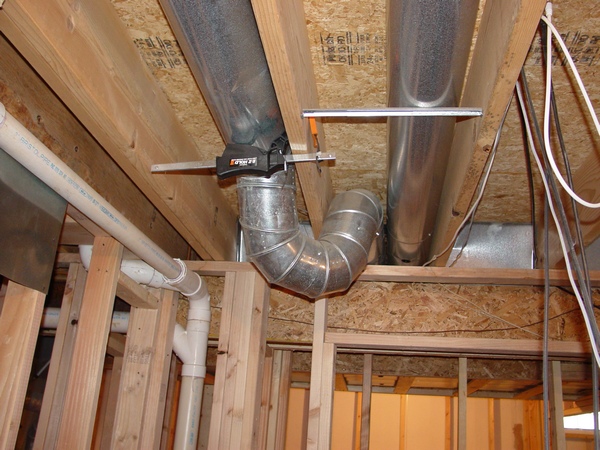
This is one of the very common cases when a heat run makes a jumper situated right where you are planning to nail drywall to the joists or drop ceiling is going to be suspended tight to the joists:

Materials


..........................................................................................................

Tools


......................................................................................................

Installation


You can see pictures in a separate window: right click on and view the image.

Installation on the paid page might not exactly describe your upcoming project. However, it will give you an important example of how this type of installation should be done. In addition, it will open the gates for as many questions as necessary to make sure that the job is done right. 


Instant Access

After you have purchased a paid page, Pay Pal will bring you back to my website. In order to see the paid page you have to click on the “Register” button, fill out a form, chose your own Username and Password and click on the “Register” button at the bottom of the form – congratulation, you are on the page you paid for!

Important: After you have purchased any Paid page or Download page and a PayPal brought you back to my website, the first thing that you should do is to save that page in your Favorites. Then if something went wrong you always can come back to re-register yourself on my website again.

                                                         Rerun of the Heat Runs in Pictures $2.00

                                                      Rerun of the Heat Runs with Explanations $2.50

Finished Basement Edition is a new book designed just for you! In this book you can find answers to your most frequently asked questions about ductwork installation in basement and more.
For more information please visit “Finished Basement Edition” page.

Copyright 2007 by Ductwork installation   Terms Of Use  Privacy Statement
DotNetNuke® is copyright 2002-2010 by DotNetNuke Corporation