Search 
Wednesday, August 27, 2008 ..:: PAQ » Ductwork In Attic ::..   Login

Ductwork in the attic runs from two sources:

  • 1. From the furnace installed anywhere in the house or in the attic.
  • 2. From the air handler installed in the house or in the attic.

There are several reasons for running ductwork in the attic:

  • 1. House is very big and spacious and there not enough walls for all heat runs and cold air returns.
  • 2. It is an existing house.
  • 3. High level of incompetence.

Here is how one mechanical inspector writing about this kind of installation:

Ductwork in an attic is normally the largest energy problem in the home or building. The reasons why this practice should be avoided are comfort complaints, heating & cooling losses in the attic ductwork and air handler, higher energy bills, maintenance difficulties and system failures.

 
SYSTEM DESIGN

In the Southeastern part of Pennsylvania, the average temperature in the winter is approximately 30 degrees and the average temperature in the summer is approximately 90 degrees. The average temperature in a properly ventilated attic should be within 20 degrees of the outside temperature. (50 in the winter – 110 in the summer) The average temperature of the air in the supply ducts in the winter is 120 degrees and 60 degrees in the summer. This is a temperature differential between the attic air and the air inside the ductwork of 70 degrees in the winter and 50 degrees in the summer.


To have a correct thermal envelope would be to have the highest point of the house be the highest R value. Attic insulation of 10+ inches (R 30), would be the best. Also all penetrations into the attic should be sealed and all joints in the ductwork and attic air handler should be sealed. However, most attics are not built with any regard to proper sealing and ventilation or heat and cooling losses.

Most HVAC contractors install cooling systems in the attic based on the theory that cold air falls down. However, the real reason most of them install them in the attic, is that it is a lot easier and less expensive to install the system. There are a number of problems with this type of installation:

ATTIC AIR HANDLER and DUCTWORK PROBLEMS:

  1. The attic air handler and ductwork system is normally insulated to R-4 and is installed above the attic insulation causing minimal resistance to heat and cooling losses through the ductwork and air handler.
  2. The size and cost of the system will have to be increased due to the cooling and heating losses through the thinner attic ductwork insulation. A larger system will be required to compensate for this inefficiency.
  3. The systems will have to run longer to make up for the losses in the attic ductwork.
  4. There is also inefficiency, due to the fact that the cooling system is generating cooling in the hottest part of the house and the heating system is generating heat in the coldest part of the house in the winter.
  5. On a typical attic installation the temperature differential from the attic air handler unit to the supply register on the other side of the house can be as much as 8 degrees. This amount of cooling loss cannot be made up with just over sizing the system.
  6. Additionally, most attic access doors/hatches are not insulated which will allow more winter heat to escape up into the attic.
  7. The attic heat in the summer time will also migrate down into the house through the ducts and attic access, making the system have to run longer to cool the warmer air.
  8. This design is very wasteful in the winter. The house heat will rise up by stack effect into the supply and return ducts in the winter, making the 10 inches of attic insulation mostly ineffective. This air will flow into attic ducts and air handler to be lost through the thinner insulation and leakage points in the ductwork.
  9. The heating system will have to recycle on and off more often to make up for this stack loss.
  10. Delivery duct leakage into attics increases the cost of operation because the system has to run longer to make up for the leakage lost to the attic.
  11. Return duct leaks allow frigid winter air to be introduced into the system, increasing the heating load.
  12. Return duct leakage in the summer pulls very hot humid air into the system, increasing cooling and dehumidification loads.

MAINTENANCE DIFFICULTIES:

In many attics the air handler system is installed in the corner, sometimes behind the supply and return ductwork. The only way to get to the filter for regular cleaning or replacement (monthly) is to climb over the ductwork, sometimes damaging the ducts. Most homeowners don’t even go into the attic to change the filter, even if the air handler is easy to access. Because of this hard to access filter, most filters are not changed on a regular basis, causing the filter and cooling coil to become dirty and clogged, reducing the efficiency and air circulation of the already inefficient system. The house will have increased operational costs and the furthest rooms from the air handler will not be cooled or heated efficiently or adequately.
 

SOLUTIONS

  1. Keep the air handler unit and ductwork inside the thermal envelope.
  2. Installing the air handler in a first or second floor closet with proper insulation and access for service.
  3. Install a proper ductwork distribution system.
  4. Install the full supply ductwork system below the upper floor ceiling, boxed into a soffit that would run down the center of the hallway of the house.
  5. All ductwork joints should be sealed.
  6. All attic ductwork should be sealed and double insulated to reduce heat and cooling losses into the attic.
  7. An air handler that must be installed in the attic should be installed inside an attic room that has insulated stud walls and ceiling, as well as sheathing on the exterior of the room.
  8. Also, install an exterior grade door for access and to maintain a proper thermal envelope.
  9. All ductwork penetrations into the room should be sealed.

Most homeowners, many HVAC contractors and architects are not aware of the problems associated with attic ductwork installations. With the above information we hope to provoke some alternative designs. 


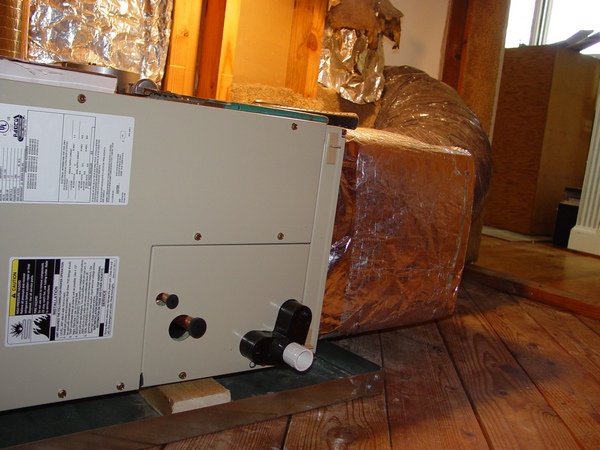
These pictures are taken from the Chapter 55 of my "Ductwork Installation Guide":
55. INSTALLATION OF AIR HANDLER – the chapter describes an air handler installation in the attic.
The chapter has 4 pictures; 2 pages.


If you would like to know more, just let me know and I'll make the Chapter 55 avalble for you!


Sharp Bends in Air Conditioning or Heating Duct Work Reduce Airflow

Sharp bends in ductwork restrict airflow (and violate ASHRAE or SMACNA guidelines for duct installations). Restrictions in airflow through duct systems increase the heating or cooling system operating cost and reduce the comfort of building occupants.
This photograph shows flex-duct in an attic making a too-tight 180 degree turn, crimping and restricting airflow in the duct system.
 

Excessive or Unnecessary Duct Lengths Increase Cooling or Heating Cost


Excessive length of ducts is often found where flex-duct is installed by an amateur. If you see a length of flex-duct snaking across an area with multiple unnecessary twists and turns, the combination of length and unnecessary bends reduces airflow, with the costs just cited above.
This photograph shows unnecessary lengths of small-diameter flex duct left by the installer. The small diameter of these ducts also tells us that we're looking at a high-velocity air conditioning system that uses a combination of small-diameter ducts and higher air velocity to deliver cooling air to the conditioned space. Flex duct runs should be as short and direct as possible without at the same time causing inappropriately sharp bends or kinks.
 

Pinched or Crimped Duct

Other common duct routing errors include sharp bends in duct work, mismatched sizes of duct work among sections, flex duct which has become crimped or pinched to restrict air flow such as in the photo at left, and of course ducts which have become disconnected.


GOODMAN GRAY FLEXDUCT - Deterioration in Hot Locations


This Goodman gray flex duct or "flex duct" air conditioning duct work material is a defective product. In hot attic spaces or where exposed to UV light, the plastic of this flexible air conditioning duct material disintegrates leaving its fiberglass insulation exposed to also disintegrate, leak, or possibly blow into the building living space. Replacement of the duct work is required - a significant expense.
Where this duct is found in a building it should be replaced.

OWENS CORNING FLEX DUCT - Deterioration


This Owens Corning gray plastic-covered, fiberglass insulated duct material is also a defective product. As with the Goodman flex-duct problem described at GOODMAN GRAY FLEXDUCT, in hot attic spaces or where exposed to UV light, the plastic of this Owens Corning flexible air conditioning duct material disintegrates leaving its fiberglass insulation exposed to also disintegrate, leak, or possibly blow into the building living space. Replacement of the duct work is required - a significant expense. Notice that not all Owens Corning flex-duct products will fail in this manner and unless you specifically find evidence of this deterioration, replacement of the flex-duct in a building may not be warranted. Where this duct is found in a building it should be replaced.
Use Feedback Module for Questions and Comments. Users of the Internet Explorer Please Use My E-mail Address: gennadyede@netscape.net


Send

 
Copyright 2007 by Ductwork installation   Terms Of Use  Privacy Statement
DotNetNuke® is copyright 2002-2008 by DotNetNuke Corporation