|
|
| Noise Reduction Search Results |
|
Noisy ducts – you can find them almost in every house, but most of the people are just used to it or were misled by their Builders. I've decided to conduct a search and find out what people are able to find on the web for this topic. I've tried Google and Yahoo for about four hours and you can see here what I’ve found:
Bunch of the Builders' sites such as:
www.goodier.com, www.beagleproductions.com, www.derekalan.com
indicate the problem this way:
Ductwork Noise:
When your metal ductwork is heated it will expand and when it cools it will contract. Some have popping or pinging sounds are the natural result of ductwork heating and cooling in response to air flow as the system operates.
That’s it, they are done, and the problem doesn’t exist anymore! So, it's looks like they show us a big, thick, probably, with a couple of calluses Builder's finger, every grown-up in this country knows what that means...
Here is another Builder showing us the same attitude:
www.pulte.com:
VIBRATION FROM HEATING OR COOLING EQUIPMENT
It is normal for heating/air-conditioning equipment to generate some noise and vibration. Under THE WARRANTY, no corrective action is required.
As you can see they are covering their butts with meaningless bureaucratic BS!
The others are taking in more informative approach:
www.askthebuilder.com
DEAR TIM:
Our new home is now three years old. Ever since move-in day there have been annoying ticking noises in several interior walls of our home. Some of the noises start minutes after our furnace comes on. The clicks then go away five minutes after the furnace shuts off. We also have cracking noises when someone takes a bath or shower in a second floor bathroom. The builder says all of this is normal and nothing can be done. We never had this problem before. What is going on and what can be done to stop these very annoying noises? Donna A. Columbus, OH
DEAR DONNA:
You are a victim of simple expansion and contraction. The ticking, clicking and cracking noises are a by-product of metal ducting and pipes and plastic drain lines that are rubbing against the wood framing members of your home. These pipes and ducts grow in size as they are heated by the warm air and water that passes through them. The expansion is a perfectly normal thing to happen, but the associated noise is not supposed to happen……
Exorcizing these demons from your walls is not going to be easy. You will need to isolate and identify the exact trouble areas. Doing this almost always involves removal of the drywall or plaster. You can then often clearly hear and see the location where a pipe or duct might be rubbing against a wood framing member. The contact zone will need to be enlarged if possible so that an air gap exists for the pipe or duct to freely move. Do not start to cut away wood or enlarge holes in joists or studs. There are strict limits to the notches and holes that can be made in framing members. You can compromise the structural integrity of your home if you take away necessary wood. If in doubt, contact your local building inspector. Many inspection agencies will gladly advise you on what you can and can't cut. They do not want you or a family member to become a statistic.
Don't count on lubricants to always solve the problem. They may be a short-term fix but over time the lubricant may dissipate. Permanent noise solution comes when you isolate the pipes and ducts from the wood framing.
Great builders and craftsmen also account for lumber shrinkage. The lumber used to frame the house can actually shrink over time. Openings that were fine during the construction phase may become tight only 6 months later. There is no substitute for experience and brains when it comes to small detail items such as this.
So, Tim actually didn't help her too much, did he? At first he suggested to enlarge the contact zone, but after that he said: don’t start to cut away the wood… so, what's she supposes to do? To cut, or not to cut? – Something Shakespearean is in this question! But it’s seems to me that Shakespeare could help better.
If Donna would find the way to my website I would help her just for $9.17 with a solution which will really work!
|

|
Ticking Noise Elimination Page
It has been more then ten years since I have discovered the way how to fight the ticking noise issue including six years since I have started helping people on the web. So now, it was time when I put all my experience together on the one webpage. On this page you can find the following:
- How to find a source of the ticking noise in your basement, wall, B-vent pipe chase or in the attic and how to quiet it down once and for all
- How to cut a drywall if the source of the noise is behind it and how to fix drywall when it is done
- What to do if the ticking noise is coming from the wall and how to eliminate it without cutting a drywall
- What to do if your ductwork is making ticking noise in the attic
- How to eliminate a ticking noise if it is coming from PVC or copper pipes inside and/or PVC concentric cap outside of your house
If after you have read on the page and you are still having a question or your case is not present on the page, you can type your question in the Feedback module on the page and send it to me free of charge.
Price for the instant access to the page is only $9.17! Just use the “Buy Now” button below.
Instant Access:
After you have purchased a paid page; PayPal is going to bring you back to my website. In order to see the paid page you have to click on the “Register” button, fill out the form, choose your own Username and Password and click on the “Register” button at the bottom of the form – congratulation, you are now on the page you have paid for!
Important: After you have purchased any Paid page or Download page and PayPal brought you back to my website, the first thing that you should do is to save that page to your Favorites. Then if something goes wrong you always can come back to reregister yourself on my website again.
|
|
www.improvenet.com
Q.When my furnace kicks on, I hear all kinds of clicks and clacks and booms in the ducts. What's the problem?
A.Your noisy ducts could be caused by a number of things. One of the most common problems is undersized ductwork, which causes the ducts on the supply side to expand as they pressurize. This in turn creates a small vacuum on the return side. In both cases, the ducts will expand and contract. When the blower comes on, the tin ducts begin making a banging sound. When the plenum causes banging noises, it normally means the return air part of your heating system is starving for air. Every warm air furnace manufacturer will give you a temperature rise number they expect to see from their unit. Check your unit by taking a temperature reading of the return air and supply air. The findings should match the manufacturer's requirements. If the temperature is too high, you do not have enough return air. This condition will shorten the life of the furnace.
On this website a guy was saying: “When the plenum causes banging noises, it normally means the return air part of your heating system is starving for air.” – But now what? What is he suggesting to do?
www.doityourself.com
Q. This is a good one. I can hear a "ticking" sound comeing from somewhere in the ductwork of my central heating system (heat pump). The ticking sound seems to be located on one specific area of the house. I almost sound like water dripping on the metal, but I don't see any signs of dripping water or rust. The sound can be heard when the heat is not running. The ticking is fairly constant in most cases, sometimes it sounds very fast an others a longer interval between ticks. I can go down into my basement with some of the ductwork is exposed. If I push up on the area where the sound is, it goes away for a short time but eventually comes back. I don't know what this is and it is driving me nuts. Any suggestions on what to look for would be appreciated!
A. Hey guy this is PDF.A quick,inexpensive remedy might be a flex collar.If your duct work comes straight off the supply and is solid all the way to your diffusers....you can purchase a flex collar.It's just a piece of sheet metal wrapping that has a canvas or rubber coupling between it.It can be bought by the foot.This may help with expansion and contraction.A sheet metal shop in your area will have it in stock.To install you will need a pair of snips,a drill and some self tapping sheet metal screws.PLEASE wear gloves!!Sheet metal has a way of slicing and dicing the fingers and hands.PDF.
This explanation is just wonderful, you just have to buy a couple of boxes of flex collars, canvas and redo the entire system of ductwork. If your life is boring or you are just on a verge of depression and decided to begin it all over again then it would be a nice start! But not to mention that these recommendations won’t work anyway. Don’t trust me try it for yourself! But PLEASE wear gloves!!
www.thisoldhouse.com – Actually this website isn’t bad at all. If you are planning some kind of remodeling project or just a minor repair go there. They even have there own videos, it’s what I'm planning to have in a near future.
But for this particular problem there is still no solution in sight:
Q: The metal ductwork in the ceiling of our finished basement pops and bangs every time the furnace comes on in the winter, then makes more noise after the furnace shuts off. Is there anything we can do to stop the banging?
A: Richard Trethewey replies:
Metal ducts make all sorts of noises. In some cases, excessive air flow can cause whistling. Sometimes, pressure differences between the supply and return ducts can move their walls in and out, resulting in a rumbling sound called "oil-canning." And ductwork can carry the sound of a noisy blower all over the house. But I suspect your problem is caused by hot air rushing into a cold duct, which makes the metal expand. You might hear some innocuous creaking, but if the duct is rubbing against wood, it might suddenly "pop" and reverberate, then pop again as the metal cools.
What can you do? Short of covering all your ducts with fiberglass insulation, or opening them up and inserting acoustic duct liners, the best you can hope for is a modest reduction in the noise. Use rubber pads to isolate ducts from wood. Make sure there's nothing blocking the air register at the return, which can lead to pressure problems. Have an HVAC technician check the system to make sure it's not pushing more air than it was designed for. And if your furnace doesn't already have a flexible transition to isolate furnace noises, ask the technician to install one.
“ Short of covering all your ducts with fiberglass insulation” – who can explain what that means?
If he is suggesting wrapping the duct with insulation, that would be a big and difficult job and it doesn’t solve the problem at all.
“or opening them up and inserting acoustic duct liners” – I’m holding my breath...... opening what up...... ductwork!!! I probably lost my understanding in English words!
This guy possibly has bolted from a kitchen. There you can easily open up a turkey and insert wherever you want: stuffing or an acoustic duct liners it just depends on what you are smoking!
I know, it is funny, but some of the visitors of my website are seriously mulling the idea of “inserting acoustic duct liners”! Folks, it is almost impossible to do! In order to do that you have to disassemble your entire ductwork system, take the ductwork apart, glue and staple it with special pins acoustic duct liner to the duct’s halves, put the ductwork back together, suspend and assemble the entire system back on!
Furthermore, some ductwork is extremely difficult to take apart, so you have to pry the seam open with the flat-tip screwdriver! After that, the seam will be pretty much destroyed and if even you will try to hammer it down it won’t hold duct halves in tact, so you have to screw them back together!
In addition, when this entire incredibly stupid and difficult job will be done it won’t eliminate the ticking (pinging) noises!
Therefore, the only benefit you are going to have after this job is done is that you may consider yourself as a professional ductwork installer and start looking for a job in this field! However, here is my advice: do not tell
this story while on the interview, the interviewer may consider that you are an idiot and will never give you a job offer!
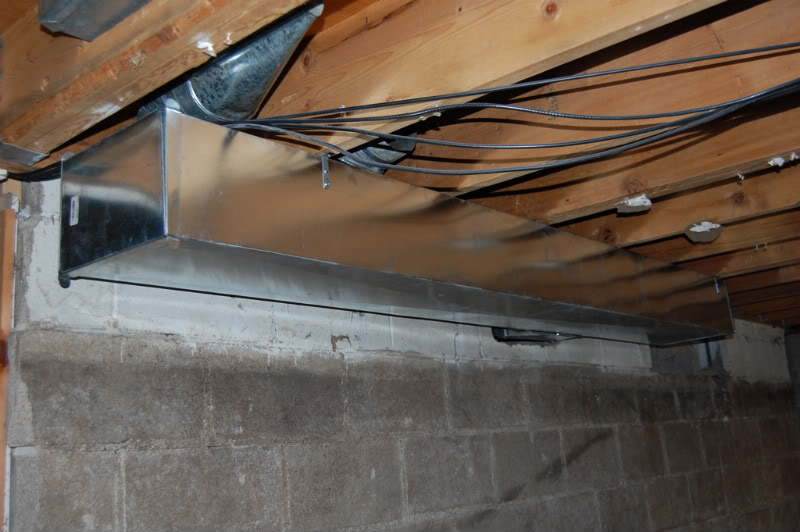 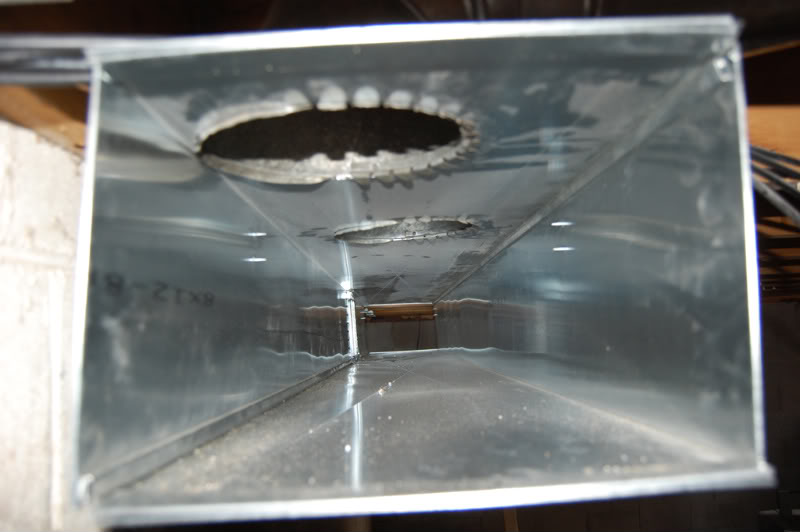 Yes, it is not a joke! I found these pictures on the web… This guy was doing DIY home theater project and he did not invent anything better but insulated a duct with an acoustic duct liner! Yes, it is not a joke! I found these pictures on the web… This guy was doing DIY home theater project and he did not invent anything better but insulated a duct with an acoustic duct liner!
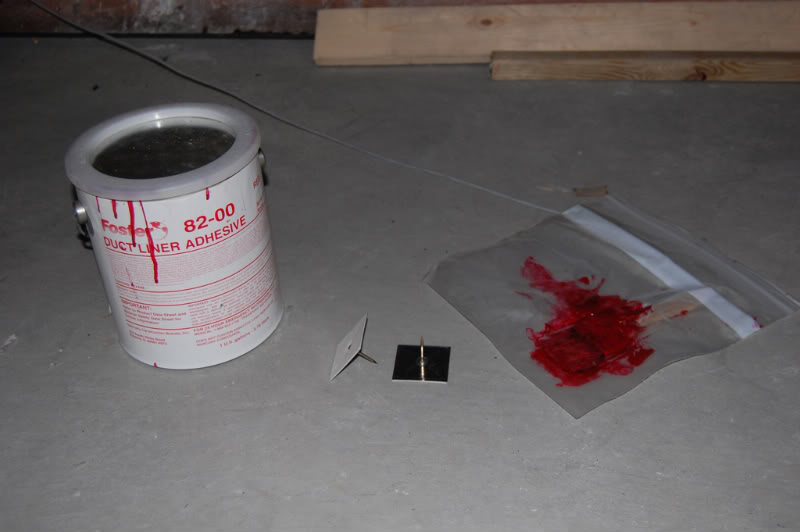 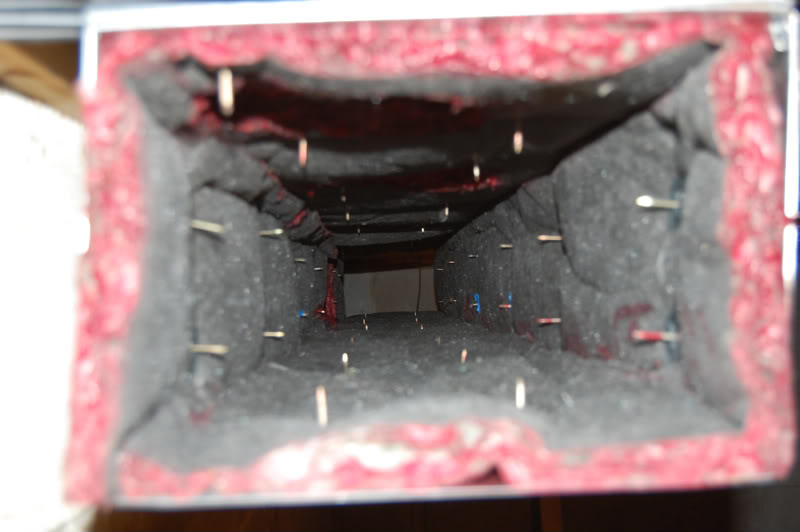
He bought some adhesive, pins and glued the duct from inside! I have no idea how he managed to do that, but he can be proud of himself, because he is definitely earned a bed in one of the mental institutions in this country.
Here is the most recent question about ticking noise which I found on the gardenweb.com:
Question:
We just replaced our 28 year old high efficiency gas furnance with a new high efficiency gas furnace. Furnace is extremely quiet, nice, service was great but it is causing a continous ticking/popping noise in the metal duct work right by the furnance about 3 seconds apart. We can occassionally here popping and ticking elsewhere but it's the loudest here. It seems when the fan runs continously it is more noticeable. In the evening it seems more noticeable too (maybe it's just more quiet). It's been 2 weeks now and we have seriously not slept. We are living in a 60s ranch and the furnace is right under our bedroom.
I understand metal heats and contracts. I told the furnace guys that maybe the heat coming out of the furnance is too hot (I read this on another website forum). They said they've only seen that happen when it's an old furnace - nowadays the airs not hot like that and it's different technology.
Could we have been sold the wrong furnance for our house? I mean why would the old one not do this and the new one does? I know now they have to put a vent to outside a pipe so maybe the heating and cooling feature causes more metal to expand contract but... it's not like we are going to get new ductwork...
What do we do?
I’m pretty sure this guy has visited my website, because it’s on the first or second pages of every search, but for unknown reasons he decided to find help some place else:
Answer:
Couple of things:
-Is the furnace the correct size?
-It could very well be contracting of metal ducts. You could try having them insulate the supply plenum – insulation of the plenum has nothing to do with the noise elimination!)--or maybe just reinstalling the small supply plenum portion (which, if it's in bad condition, really should have been included in a complete, professional installation).
Possible causes for your problem,
Furnace oversized (let's hope not) – it can’t be the cause of the problem!
Blower speed set too high (easy to fix) – it also has nothing to do with the problem!
discharge temp too high (when the installers told you they had not seen that with this "new technology did they have a temperature sensor in their hand)
some foriegn matter in the ductwork like a loose piece of metal, tape or insulation(this is most likely your problem as you say you hear it with the fan on. – Loose piece of metal can’t make the ticking noise – period!
Here is how a website: www.ehow.com taking a shot to the ticking noise issue:
If you're heating duct is making noise, it's a matter of expansion and contraction. – This is true! The ducting and pipes are rubbing up against the wood framing members in your walls. When warm air passes through ducts and pipes, they expand. Suddenly, they're rubbing against the wood frame, creating the annoying noise. The only way to eliminate the noise is to isolate the ducts and pipes from the wood framing. – This is true again!!
Step1
Figure out exactly where the heating duct noise is coming from. To identify the problem area, remove the plaster or drywall, and then listen for the heating duct noise. Look along the duct or pipe to see where it's rubbing against your home's wood framing. – Good boy!!
Step2
Enlarge the spot where the ducts or pipes come into contact with the framing. You want an air gap to exist so that the heating duct or pipe can move freely. – Enlarge? But how? If you will try to cut framing you may cut a duct or copper pipe!
Step3
To avoid threats to the structure of your home, don't bore bigger holes in the studs or joists and don't cut away the wood. – Well, well, well here we go again! This dude probably reads Tim’s advise above!
Step4
Use a lubricant to ease the problem. This probably is a temporary fix because the lubricant may dissipate over time. – This is true, lubricant will be absorbed by wood over time!
Step5
Hire a heating contractor to insert flexible insulation ductwork between the furnace and the ducts if what you're hearing is a pinging, metallic sound. – This one won’t work at all, but this one lies in the main goal of that website: just give you a hint how to resolve your problem and send you to a heating contractor as soon as possible! Don't believe me check it out for yourself!
Here is one more thread from the Forum website:
BigSwede
Ductwork Banging/Popping
My ductwork has an issue where it makes a banging or popping noise when it expands or contracts. It’s not coming from the furnace but definitely the ducts. I have a two-storey home with a finished basement that is 7 years old. I have owned the house for 2 years and have had this issue the whole time. The previous owners said they had an HVAC guy look at the issue but were told that it isn't causing any damage so just live with it. – Sounds familiar!
It seems to happen in the 1st level floor joists ( basement ceiling ). I have popped off some of the drop ceiling tiles and noticed that the ductwork sits on 2"x2" wooded crossers between the floor joists. Is this proper? I'm thinking that the expansion or contraction of my ducts resting on the wood reverberates through the floor joists making the rather loud banging noise.
Just to isolate the issue to ductwork, there are no cracks in my walls to indicate shifting foundation. Plus, I've noticed that when I raise or lower the temp the bangs become more frequent and when I keep the temp constant I may get one or two bangs per day.
Has anyone ever run into this problem before? Any suggestions would be greatly appreciated. – Well, I am runing through this problem almost on a dayly basis, why did you not ask me for help?
airman.1994
The contractor that installed the duct went the cheap way! Most do! They did not cross break the metal or they did not use a heavy enough gauge. You could take some thicker metal and screw it to the bottom of the duct to help it be more ridged. – No comments so far, just read and injoy!
BigSwede
Thanks for the reply. You say to screw thicker metal to the bottom of the duct. These are 5" circular metallic ducts. How exactly should I go about screwing the metal to the ducts? - OK, I hope you got it! Airman is probably so drunk he even does not understand what is going at!
Also, what do you mean by "cross break the metal"? I've also heard that ducts should be supported by hangers whereas mine are supported by wooden crossers between the floor joists. Should I look into hangers or just leave them the way they are?
This is funny, but it is not over yet! Airman. 1994 keeps posting nonsense, but BigSwede keeps pushing him:
Airman. 1994
So all you have is round duct and no square? – How is this guy caming to this conclusion?
If that is the case you will have to replace the round pipe. – Replace the round pipe? This becomes really insane!
The wood is OK! Not the best but OK. – No, it is not!
Id say if the trash installer cut these corners what else did he do. I would have a good HVAC company come out and take a look at the system. Might save you lots of money in the long run. – Might save money on what?
BigSwede
I thought that round ductwork is normal. The main duct coming from the furnace is square but the duct pipes that branch off the main duct are round. These are the pipes that are sitting on wood and seem to be making the popping noise. Is there anything that can be done to the round ductwork to reduce popping? Thanks again.
Airman. 1994
Never heard round pipe pop! – Of course, only beer pops sometimes!
Must be very light gauge. How about running a screw from the wood into the duct. – This is an interesting idea! Run a screw through 2”x 2” wood it’s the best way to crack it
BigSwede
I may give that a try. It may be coming from the main square duct but I'm almost positive its the circular ducts making the noise. When you talk about cross breaking the ducts, what do you mean? Also the part about screwing more solid metal to the bottom, do mean to screw a sheet of metal or a rod? Thanks. – Questions, questions, more and more questions…
furd
I agree with airman, snap, crackle and pop of round duct just doesn't happen. Unfortunately it IS common with light-gauge rectangular duct. – "I agggreee withth air-airmannn"- Another “pro” just emerged, probably from the same pub!
What airman means by the term "cross breaking" (or braking) is that when the duct is bent up from a flat sheet of metal the brake (bending machine) is used to put slight creases in an X pattern across the wider section of the duct. It adds tremendous stiffness and prevents (in almost all cases) the duct from doing the snap, crackle and pop from changes in temperature and internal air pressure.
BigSwede
Most of my rectangular ducts are inaccessable as they are in bulkheads. Some I may be able to access the tops only. Are there any ideas on how to minimize this situation or possibly fix it?
That is it, no more follow-ups. Does it worth saved $9.17? You decide!
To sum up: I really tried hard and I wasn’t capable of finding any good advice for this particular problem. I understand it’s difficult to spend even $9.17 when you are not sure about a result. However, you have four choices:
1. Live with the noisy ductwork for the rest of your life and hope that one day you will get used to it or sell the house!
2. Get all the information for free from the web, but don’t waste your time look above: I already wasted it for you.
3. Hire a heating contractor, spend hundreds of dollars and at least you will find someone to blame!
4. Pay $9.17 and get a real solution! |
|
Banging or Oil-Canning Noise Elimination Page
This page is dedicated to the banging (oil-canning) noise elimination issues. On this page, you can find the following:
- How to find a source of the banging noise in your basement and how to quiet it down once and for all
- What to do if your ductwork was wrongly designed or installed and this is a part of the banging noise issue
- What to do if they used wrong jousts in your house and as a result you are experiencing an oil-canning noise
Price for the instant access to the page is only $4.95 ($4.50 + $0.45 - PayPal's fee)! Just use the “Buy Now” button below.
Instant Access:
After you have purchased a paid page, PayPal is going to bring you back to my website. In order to see the paid page you have to click on the “Register” button, fill out the form, choose your own "Username" and "Password", and click the “Register” button at the bottom of the form – congratulation, you are now on the page you have paid for!
Important: After you have purchased any Paid page or Download page and PayPal brought you back to my website, the first thing that you should do is to save that page to your Favorites. Then, if something goes wrong, you always can come back to re-register yourself on my website again.
|
|
Ticking Noise Elimination and Banging or Oil Canning Noise Elimination Bundle
Purchase an instant access to the Ticking Noise Elimination and Banging or Oil Canning Noise Elimination pages and save!
Price for the instant access to the pages is only $10.62 ($10.00 + $0.62 - PayPal's fee)! Just use the “Buy Now” button below.
|
|
|
A website "ductworkinstallation. com" focus on providing information and services related to the installation of ductwork systems , which are the tubes used to distribute heated or cooled air throughout a building as part of an HVAC system; essentially, it would be a platform for individuals or companies specializing in designing and installing ductwork for homes and commercial properties, offering details on the process, and potential contractors to contact for such services.
Key points about ductwork installation websites:
Services offered:
New ductwork installation, ductwork repair, duct cleaning, duct sealing, airflow balancing.
Target audience:
Homeowners looking to install a new HVAC system, individuals experiencing issues with their existing ductwork, commercial property owners needing ductwork for large buildings.
Information provided:
Explanations on different types of duct materials, design considerations for optimal airflow, potential benefits of proper ductwork installation.
|
|