Search
Monday, February 06, 2012 ..:: Energy Saving » Water Heater ::.. Register  Login

"Supply Registers and Return Grilles"
Depending on the location of the supply register, an air distribution system could be described as a perimeter system, a ceiling supply system, or an inside wall supply system. Some general comments about the strengths and weaknesses of these systems are made below.
Perimeter Systems:
Perimeter systems blanket portions of the exterior walls with supply air. This is accomplished by using floor, baseboard, or low sidewall outlets that are designed to discharge the supply straight up the wall. If the outlets are sized correctly, the discharge pattern will extend up to the ceiling. (Never use outlets that blow air into the interior of the room.) It is also possible to use ceiling outlets that discharge air straight down the wall, but this arrangement is more suited for heating rooms that cannot be served by a below-the-floor duct system. (Discharging cold air straight down a wall will cause the air to stratify along the floor. A horizontal, parallel to the ceiling, discharge is preferred for cooling.)
Traditionally, perimeter systems have been recommended for buildings that are located in cold climates because they provide more comfort at the floor level than the two other types of systems. However, ceiling or inside wall systems can be used in a cold climate if the building has a thermally efficient envelope and a heated room (like the first floor of a 2 stories or basement) below the room the perimeter system will be installed.
Ceiling Supply Systems:
Ceiling supply outlets should discharge air parallel to the ceiling. If ceiling outlets are sized correctly the discharge pattern will extend to the walls. (Never use outlets that blow the air down into the interior of the room.) Ceiling systems provide optimum performance during the cooling mode, so they are commonly used in buildings that are located in warm climates. (Cold floor problems could be experienced during the heating season when ceiling outlets are installed in a building that has an exposed floor.)
High inside WallSupply Systems:
High sidewall supply outlets should discharge air parallel to the ceiling toward the outside wall. If the outlets are sized correctly, the discharge pattern will extend to the opposite wall and high velocity air will not drop into the occupied zone. (An excessive drop during the cooling season is a common problem that is associated with sidewall outlets.) Sidewall outlets perform best during the cooling mode, so they are more suitable for buildings that are located in warm climates. (Cold floor problems could be experienced during the heating season when high sidewall outlets are installed in a building that has an exposed floor.)
Now let’s talk about the return air grille locations. Return duct systems are commonly characterized by the number of the return openings. Return inlet locations, duct run geometry, and duct material are secondary features that can be used to describe a return air system.
Number of Return Inlets:
Return duct systems can be classified as a single central return system, a multiple return system, or as a system that has a return in every room. Regardless of which type of return duct system is used, there must be a low-resistance return air path between every room and the building HVAC unit. A system that features a properly sized return in very room automatically satisfies that requirement. If a single return system or a multiple return system is used, there must be a low resistance path between every isolated room and the closest return air opening. This can be established by using jump ducts, wall transfer grilles, or door grilles. (Observe caution as to not increase noise, or air velocity issues.)
Return Inlet Location:
Return air duct systems can be characterized by the location of the return air openings. If all of the return openings are installed in the ceiling or located high on the walls, the system is called a "high return system". If located in the floor or low on the sidewall then it is referred to as a "low sidewall system". Since the return air location (high or low) has negligible effect on the air motion within the room, the return openings should be placed at positions that are compatible with the HVAC unit and duct runs. Return openings do not need to be located on the opposite side of the room from the supply, and the return does not "draw" the air across the room. The return opening is simply a path for the air from the room to return to the HVAC unit.
The air motion within the occupied zone depends on the performance of the supply register. If the register is sized correctly, the jet of conditioned air will join with a large amount of room air as it develops into a secondary air pattern. The supply air mixing with the air in the room causes a secondary air pattern that is 10 to 20 times greater than the register supply air cfm. Even more mixing will take place as the secondary air exchanges its momentum with the room air. Selecting the correct supply air register is important to insure the mixing action takes place outside the occupied zone, which means it must occur near the walls or ceiling. Ultimately, all of the air in the occupied zone will be induced into motion and there will be no drafts or stratified air in the occupied zone. Stratification does not cause discomfort if it occurs outside of the occupied zone, such as near the ceiling.

High Efficiency Water Heater

If you have this type of Power Shot high efficiency water heater as you can see them in the picture, you actually can save not only some money but even reduce some noise! My first desire when I got this water heater installed was to reduce the noise. Everyone who has this noisy bastard in his or her house knows that this bloodsucker can wake you up in the middle of the night even if you are sleeping on the second floor!
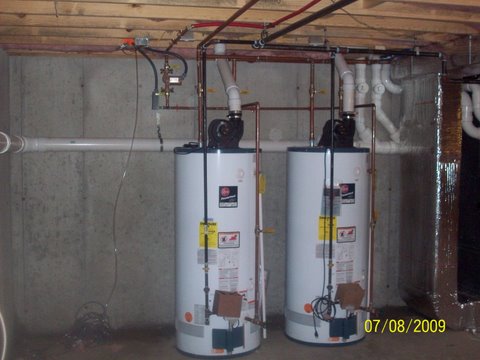
Therefore, I have decided to run ................
And after installation I’ve discovered two things:

• I’ve twice reduced level of the noise
• I’m saving some energy, because this water heater stealing less of the conditioned air from my house


If you would like to read more, please use the “BuyNow” button below and you will gain an instant access to the eighth Chapter of my Energy Saving Edition book dedicated to the energy conservation issues!
In Chapter, you will learn how to save energy and reduce noise by improving your water-heater exhaust and how you can do it by yourself.
The chapter has 2 pages and 3 pictures in it. Price of the chapter is only $2.50.

Instant Access:

After you have purchased a paid page, PayPal is going to bring you back to my website. In order to see the paid page you have to click on the “Register” button, fill out the form, choose your own Username and Password, click on the arrow at the top of the page, move the form up and click on the “Register” button at the bottom of the form – congratulation, you are now on the page you have paid for!

Important: After you have purchased any Paid page or Download page and PayPal brought you back to my website, the first thing that you should do it is to save that page to your Favorites. Then if something goes wrong you always can come back to re-register yourself on my website again. 

Water Heater Noises

Your water heater can make noise in a variety of ways ranging from hissing, popping, tapping, banging, and even jackhammer sounds. Some are indicators of problems while others are just age and improper maintenance that really are not much of a concern but will go away when the water heater is eventually replaced.

A hissing or, popping sound when the water heater is reheating is one of the more common sounds a water heater makes. When water is heated the water molecules expand taking up more room leaving less room for other things in the solution. The hardness minerals dissolved in the water such as lime feel this molecular expansion and precipitate out of the solution falling to the bottom of the water heater. The minerals build up on the bottom of the water heater and if you do not periodically flush the water heater will eventually coat the bottom of the water heater and may even cover the lower element in an electric water heater. This thick layer of minerals acts as insulation and keeps the water from having direct contact with the element of bottom of the tank. Water entrapped in the blanket of minerals being heated by the element on an electric water heater or, by the bottom of the tank on a gas water heater actually makes a series of small steam explosions as it is heated making hissing and popping sounds. If you have waited this long to flush your water heater the build up is probably quite hard and will not break up with just flushing. With gas water heaters the efficiency of the units will suffer, as the heat does not pass through the blanket of minerals as efficiently. With electric water heaters the build up covering the lower element will also affect heat transfer and many times will cause the element to overheat and burn out. With electric water heaters it is possible when changing a lower element to reach in through the hole for the lower element and break up the minerals so they may be flushed out.

A tapping noise or, buzzing noise when water is flowing can be caused by heat traps installed on the inlet and outlet of your water heater. Heat traps are basically small automatic valves that seal the inlet and outlet of the water heater when water is not flowing keeping the heat inside the insulated water heater instead of allowing the heat to escape into the pipes where it would be lost. Some manufacturers use heat traps that use a mechanism like a marble to seal the heat in. When water is flowing the “marble” moves in the flow making a tapping noise. Other manufacturers use heat traps, which have a flexible flapper type valve. This flexible flapper may vibrate at certain flow levels causing a buzzing sound when water is drawn. These sounds are generally harmless and will seem loudest at the inlet and outlet although the sound may transmit some distance away.

A banging noise when the water is shut off is usually water hammer. Water hammer is caused by the momentum of the water moving in the pipe coming to a sudden stop. The noise will often be a series of bangs louder at first and tapering off then stopping. Pipes that are not properly secured moving from the momentum can be a cause as well as excessive velocities of the flowing water in the pipes. Undersized pipes, and or, excessive pressure can cause the higher velocities. The pressure of your water supply should not exceed 80-psi and if it does a pressure-reducing valve should be installed in most cases with the pressure-reducing valve a thermal expansion tank should also be installed. Excessive velocities in a pipe may cause erosion of the pipe material resulting in leaks. Water hammer is a problem that may cause damage to components of your water supply system and should be addressed.

Jackhammer sounds are almost always accompanied by pulsations in the flow of water. This is usually caused by something loose in the stream of water, which in a sense is turning the water on and off rapidly making a constant series of water hammer type noises. These noises will often vary with the flow volume and may often disappear or, appear only within a certain flow range. Many times the loose debris may be a rubber washer on a valve that has come loose often from recent use. This is something that should be addressed as often it indicates a valve that will no longer function.

In any case while some noises may be harmless and not require any attention some may be serious and require repairs. For your safety it may be best to have a plumber check the noise out for you and determine its cause and if repairs are needed. Some noises particularly those relating to a gas burner operating on a water heater may be very serious and it is better to be safe than sorry.

Tags

water heater draft inducer noise,

Copyright 2007 by Ductwork installation   Terms Of Use  Privacy Statement
DotNetNuke® is copyright 2002-2012 by DotNetNuke Corporation