|
|
|
Light Commercial
For years I was thinking about writing a Light Commercial E-book and this idea never came to fruition...
Currently I'm working as a basement ductwork installer (ducter) for new residential applications, I'm 57, and I don't think that I will work as a light commercial installer ever again...
However, this idea of creating a comprehensive Light Commercial Ductwork Installation E-book is still alive and well and I hope that you can help me and others to make it work for everybody!
Participation Rules
If you decide to participate in the project:
- E-mail me from this page
- Choose a chapter (chapters) below and write your version
- E-mail me your text with pictures
- E-mail me improved text of the existing chapters and submit new pictures
Benefits
- If you are a ductwork installer you are going to improve your skills
- If you are an owner of the HVAC Company you are going to have a great tool to educate your installers and you won't be alone!
- Your name and your company's name (optional) will be printed right below chapter's title
Chapters
- Introduction
- Tools
- Materials
- Curb and Flashing Installations
- Roof-top Unit Installations
- Plenum Installation
- Ductwork Installation
- Cold Air Returns
- Heat Runs
- Duct Sealing and Insulation
- Duct (Smoke) Detector Installation
- Bath Fans - Installation and Venting
- Tube-type Infrared Heater Installation
- Industrial Unit Heater Installation
- Split System Installation
- Energy Recovery Ventilator Installation
Any other chapter you may think of...
Ductwork Installation
When I was writing my “Ductwork Installation Guide” I've considered that the next guide is going to be to light commercial ductwork installation. But I wasn’t sure that there is a market for this kind of a manual.
However, nowadays a slump in the house market is driving HVAC companies from residential to light commercial installation. If you are working in this kind of company you may face a different environment and meet unexpected difficulties.
In general, light commercial installation is easer than the residential one, but it requires a different approach and an installer constantly finding different types of equipment and ductwork to install. Someone can do the work for 10 years and still find something new . Also different kinds of commercial buildings will make an installer run even a familiar system of ductwork differently. So, I've decided to create this page on my website.
The purpose of this page is:
- To help newcomers with all my knowledge to accommodate a new profession.
- To find out for myself if anyone actually needs this kind of help.
So, if you have any questions you can contact me on this page.
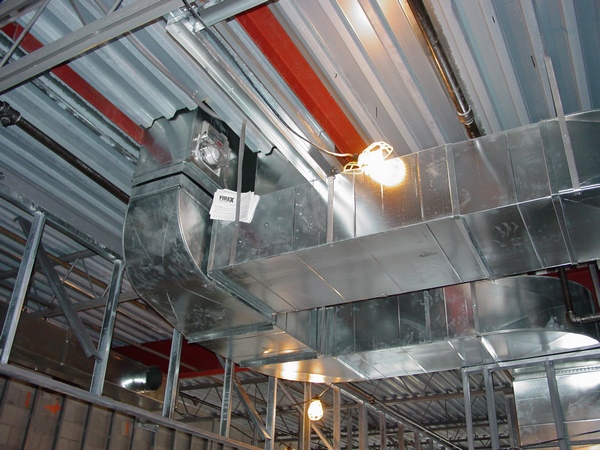
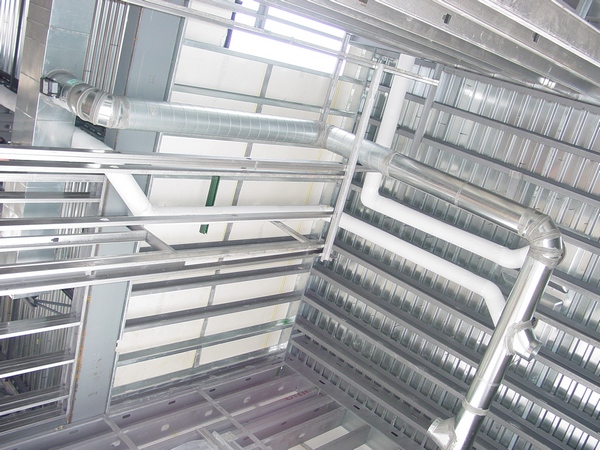
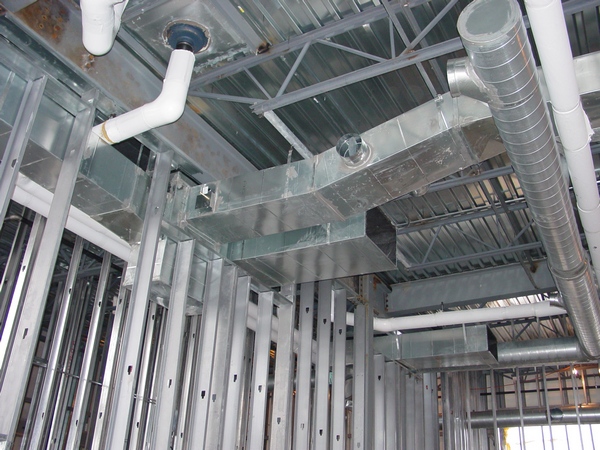
Here you can see some of the pictures which I took a long time ago for the “Light Commercial Ductwork Installation Guide”:
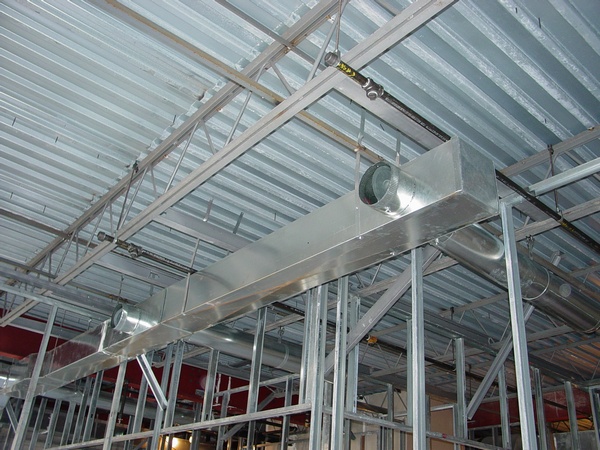 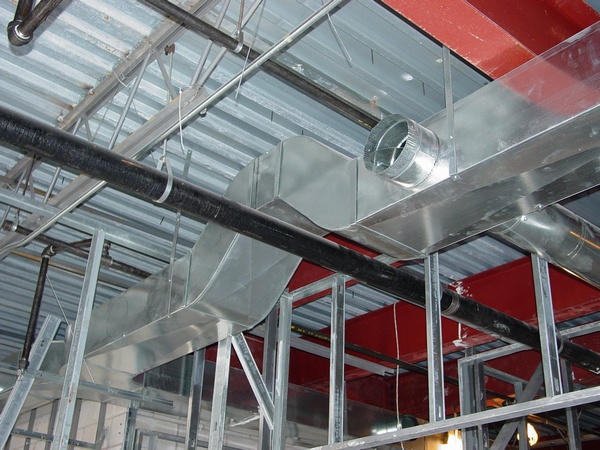 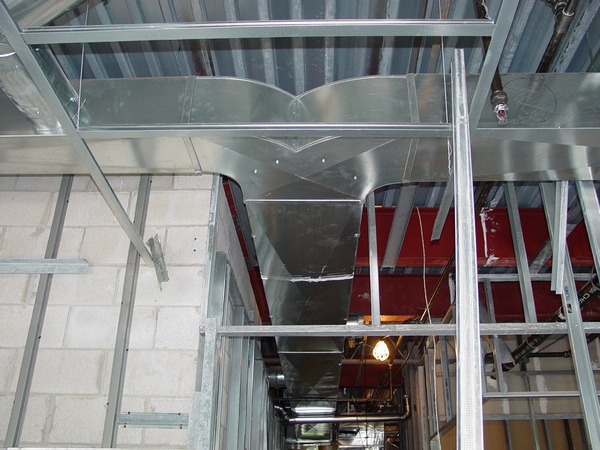 Supply duct Supply duct above the sprinkle line Y-branch Supply duct Supply duct above the sprinkle line Y-branch
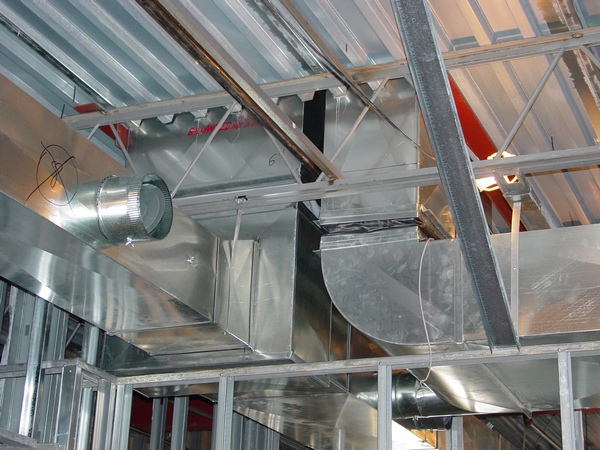  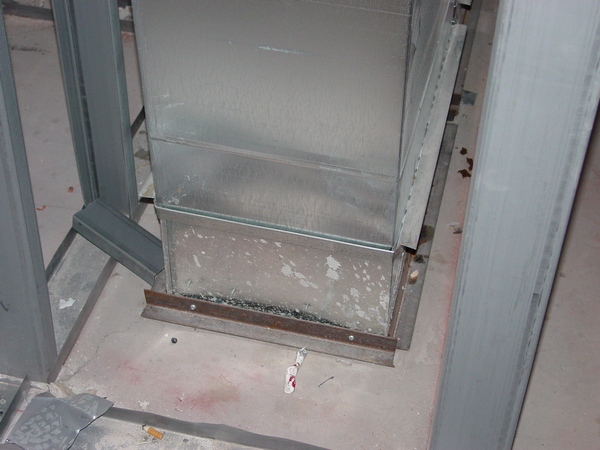 Connection of the supply duct to the plenum Smoke detector Floor penetration Connection of the supply duct to the plenum Smoke detector Floor penetration
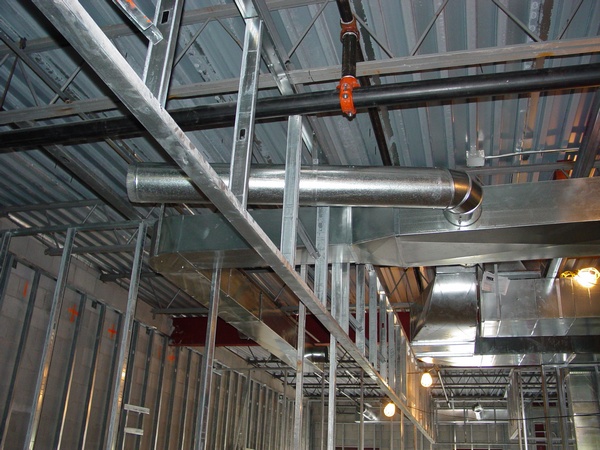 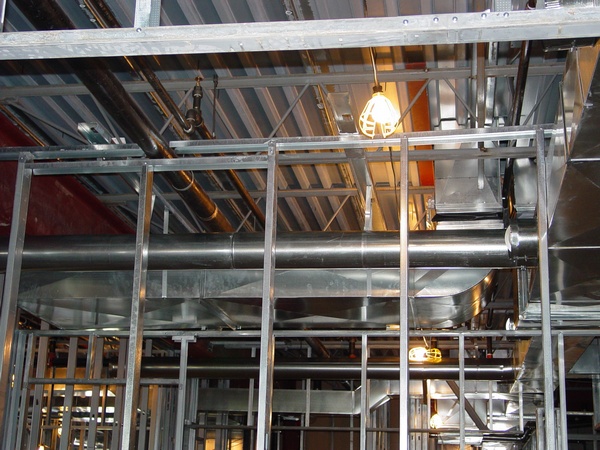 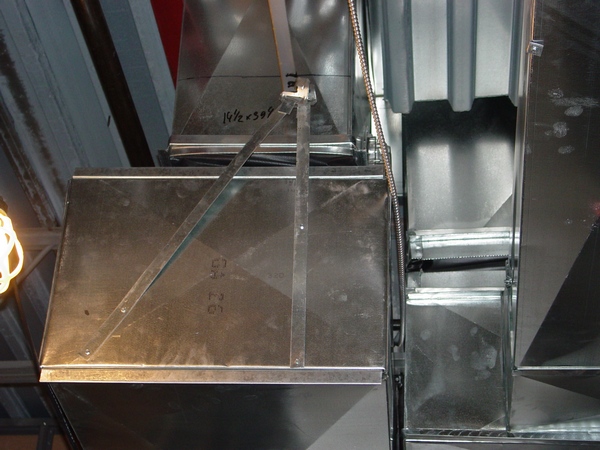 8” heat run 8” heat runs Duct hanging 8” heat run 8” heat runs Duct hanging
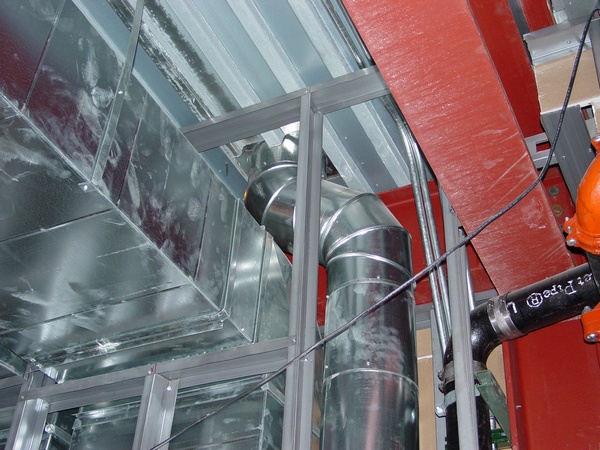 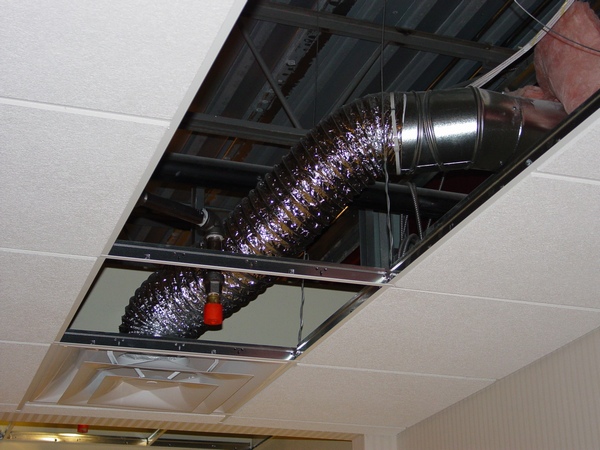 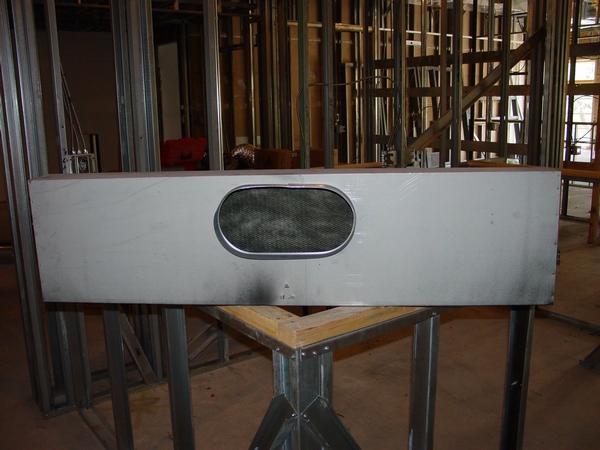
Bath fans exhaust pipe Diffuser connection Linear Register
Question:
“me and a guy are hanging commercial duct we both have 10+ years experiance between us when we come off the sicissor lift to look down at the duct work it looks twisted, we are very experienced at hammering duct work together, i dont get why it is twisted, the duct goes together easy with drives”
So, here are several rules you have to follow when running the duct:
1. Hangers:
- It’s always better to put all hangers on for the same duct size.
For example, if you have to install a 40’ of 30” x 14” duct and the distance between the trusses is 6’ you have to hammer on 6 pairs of hangers.
- When you are measuring where the hangers should be cut, use an electrical conduit. They are always 10’ long and it’s very easy to put on an additional piece to length.
2. Ductwork:
- When you snap a piece of duct together it would be better if sides are matching, but it’s not a big deal if not.
- Don’t put any screws in the seams.
3. Hanging the ductwork:
- Every next piece of duct must be hung with the seam on a different side.
- Don’t screw a hanger to the bottom of the duct if there is a seam.
- Don’t try to fix twisted ductwork until first transition or 90* is installed or all the system will be done.
- If the system of the ductwork is twisted push the corners which are down and up from both sides.
- Secure you job with the screws at the bottom of the ducts.
Space Cooling Load Calculations
|
| Curbs Installations
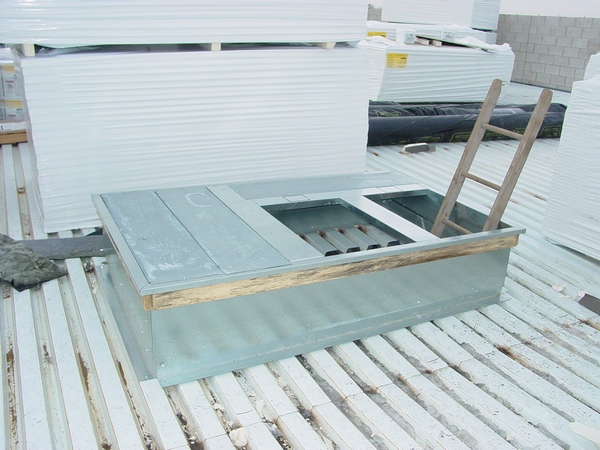 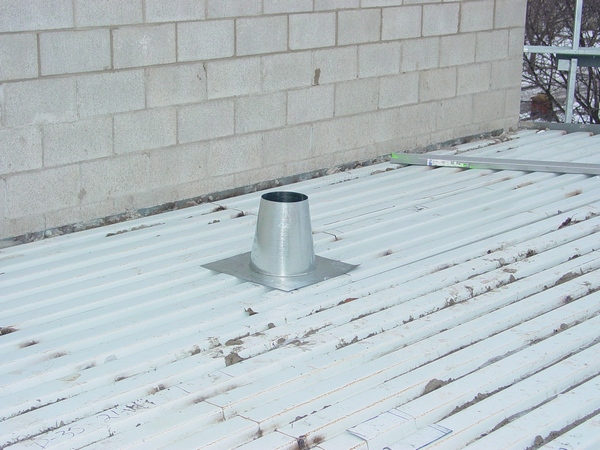 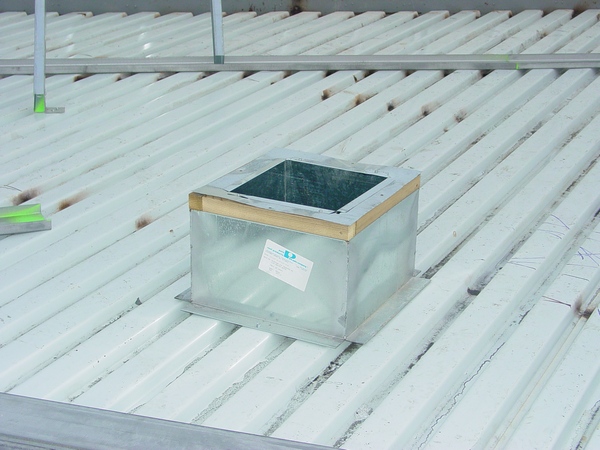
Adjustable curb Tall cone Curb
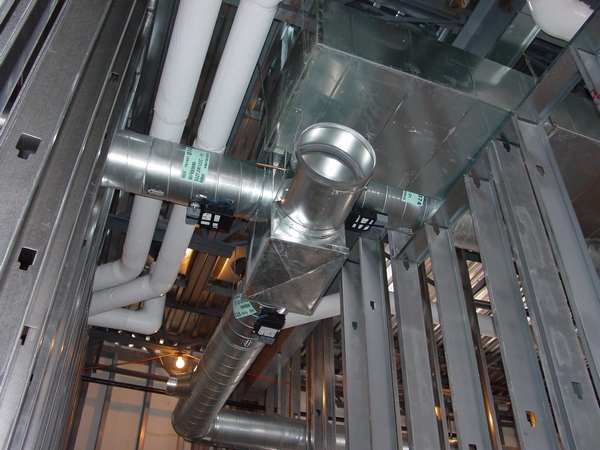   Zoning, bypass damper Round ductwork Zoning damper Zoning, bypass damper Round ductwork Zoning damper
Question:
I would like to know how the hangers are attached to metal beams. Also were the fire dampers should be in commercial applications.
Thank you.
Answer:
Hangers or straps usually are attached by “Caddy strap hangers”. There are several types of them, but 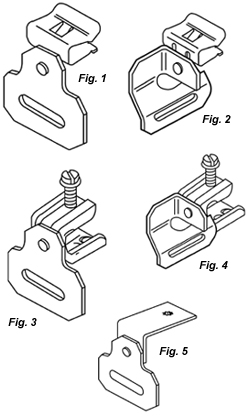 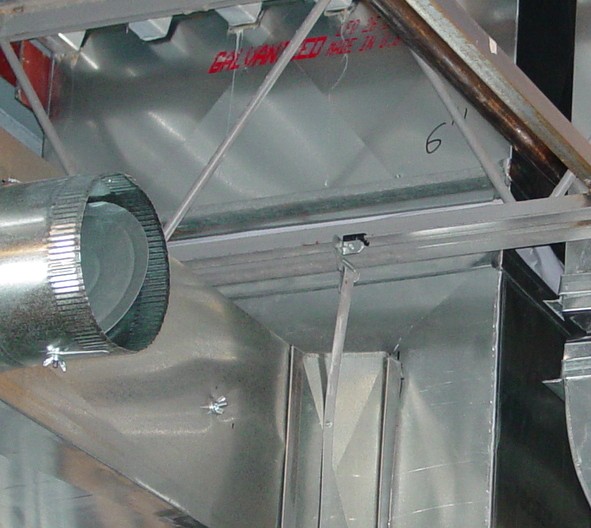 the most usable are shown on fig.1 (twisted) and fig. 2 (straight). the most usable are shown on fig.1 (twisted) and fig. 2 (straight).
In order to attach the hanger strap to the “Caddy strap hanger” you have to fold approximately 1” – 1 ½” of it by using simmers, long nose pliers or hands, hook up the caddy strap and smash the hanger strap with the hammer. After that you just have to hammer it to the metal beam.
Because there are many types of metal beams: some of them are thinner and some of them are thicker, the “Caddy strap hangers” are made to fit thicker or thinner applications.
|
|
Custom Designed HRV by John L.
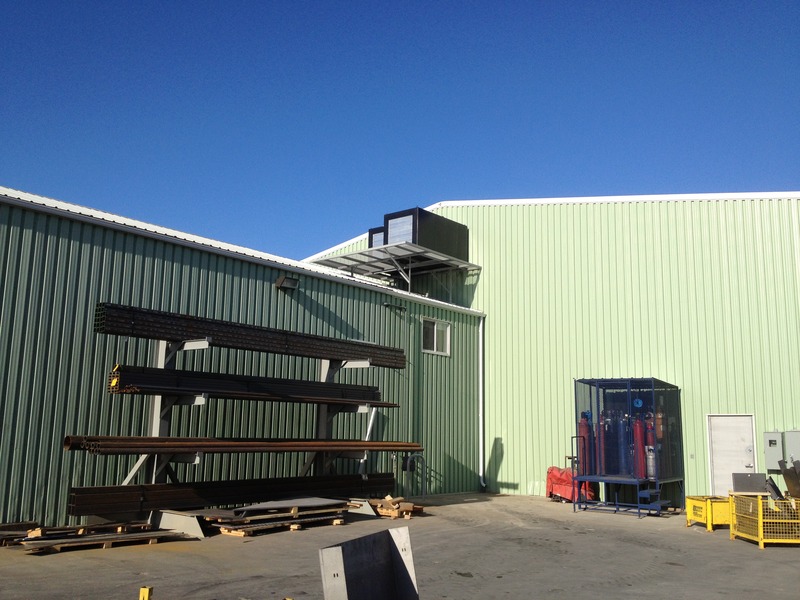 This system was installed a few years ago as a prototype. This system was installed a few years ago as a prototype.
We sell a great little air to air heat exchanger for welding shops called "Keep The Heat".
Their only real drawback is that they only make one size of unit that exhausts about 1500 CFM.
If a customer needs more air flow they just add more units to achieve the desired total.
We ran into a few jobs where the customer simply didn't have enough room to install the required number of systems...
|
|
|
A website "ductworkinstallation. com" focus on providing information and services related to the installation of ductwork systems , which are the tubes used to distribute heated or cooled air throughout a building as part of an HVAC system; essentially, it would be a platform for individuals or companies specializing in designing and installing ductwork for homes and commercial properties, offering details on the process, and potential contractors to contact for such services.
Key points about ductwork installation websites:
Services offered:
New ductwork installation, ductwork repair, duct cleaning, duct sealing, airflow balancing.
Target audience:
Homeowners looking to install a new HVAC system, individuals experiencing issues with their existing ductwork, commercial property owners needing ductwork for large buildings.
Information provided:
Explanations on different types of duct materials, design considerations for optimal airflow, potential benefits of proper ductwork installation.
|
|